













Detectives make difficult decisions all the time as we try to determine who is telling us the truth, who is worthy of further investigation, or who is ultimately the suspect in a case. Detectives must be discerning, separating truth from deception, and truth-tellers from deceivers.
But I often encounter Christians who are less than discerning, especially when it requires them to make difficult decisions about people. There’s a subtle but pervasive belief that real faith means refusing to judge others and trusting that God ultimately has it all under control. Many of us are concerned about being unloving and prideful when we “take matters in our own hands.” There’s a subtle but pervasive belief that real faith means refusing to judge others and trusting that God ultimately has it all under control. Share on X
While it’s true that God is the final authority and judge of all that happens in human history, Christians ought not be hesitant to apply discernment to people, ideas, and claims. There are many examples in the New Testament of Christ-followers engaging people and ideas, weighing the evidence for their claims and acting decisively for the sake of the Christian community and the truth of the Gospel. Here is an evidential review of discernment as described and modelled in the New Testament:
Jesus Set the Standard
In Matthew 18:15-17, Jesus lays out a clear process for confronting a brother or sister who sins: first privately, then with witnesses, and finally before the entire community. If the person refuses to listen at every stage, Jesus says, “let him be to you as a Gentile and a tax collector.” That’s not a call to harsh exclusion, but a call to make a real, consequential decision for the sake of truth and the Christian community. Jesus expects His followers to exercise judgment—not as self-appointed moral police, but as those entrusted with the integrity of the community. This will sometimes mean excluding people and ideas.
Peter Exercised Discernment

The early believers took this responsibility seriously. In Acts 5:1–11, for example, Ananias and Sapphira attempted to deceive the church about their offering. Peter didn’t defer responsibility or hope God would sort it out in the end. He confronted the deception directly, exposing the lie for what it was. The consequences were sobering, but the lesson was clear: truth is important, and the integrity of the church matters, and leaders are expected to discern and respond when either of these are threatened.
Another striking example can be found in Acts 8:18–23, when Simon the Sorcerer tried to buy the power of the Holy Spirit. Peter discerned the true motives in Simon’s heart and rebuked him sharply. Peter didn’t shy away from making tough calls when the evidence demanded it.
Paul Exercised Discernment
Paul’s letters to the early Church were explicit when it came to making tough decisions about people, their claims, and their behavior. In Corinth (as described in 1 Corinthians 5:1–13), a man’s public immorality was poisoning the church’s reputation and unity. Paul didn’t suggest a hands-off approach, suggesting, for example, that the church simply pray for the man and hope for the best. Instead, he commanded the congregation to remove the man from fellowship—not out of spite, but in hope that this decisive action might ultimately lead to repentance and restoration.
Paul’s instructions in Romans 16:17 were similarly direct. He urged believers to “watch out for those who cause divisions and put obstacles in your way that are contrary to the teaching you have learned. Keep away from them.” This isn’t a suggestion to passively tolerate every opinion or behavior in the name of unity. It’s a call to discernment and exclusion, a call to protect the community from those who would undermine its foundation. Paul insisted that the church judge those within its own ranks, making hard decisions for the sake of the larger community.
Discernment in the New Testament wasn’t just for apostles and church leaders. Paul listed it as a spiritual gift in 1 Corinthians 12, even as he commanded all believers to “test everything; hold fast what is good.” Paul, like every other early believer and New Testament author, understood the importance of bringing our full intellectual faculties to bear on the challenges we face as a community. This means rightly dividing truth from error and rightly excluding liars from truth tellers.
John Exercised Discernment
John echoed this same interest in discernment when he urged believers in 1 John 4:1 to “test the spirits.” The early church was infiltrated by competing claims and charismatic personalities. John could have written, “Trust God to sort it out.” Instead, he commanded believers to evaluate, investigate, and reject what was false. The health of the community depended on their willingness to discern truth from error, even when it meant drawing lines and making exclusions.
Each of these examples demonstrates that the New Testament vision for the church is not one of passive tolerance, but of wise, courageous engagement. The goal was never exclusion for its own sake, but the protection and restoration of the Christian community. Discernment is always relational, redemptive, and aimed at the good of all involved.
So ask yourself: Do you occasionally hesitate to exercise discernment because you fear being judgmental? If so, remember that the New Testament draws a sharp distinction between hypocritical judgment and wise discernment. The former is rooted in pride; the latter, in a deep concern for the well-being of others and the integrity of the faith.
A faith worth believing is a faith worth investigating. The call of the New Testament is clear: love God with all your heart, soul, and mind. Test everything. Hold fast to what is good. Reject what is false. Protect the community. Exclude the unrepentant. Restore the fallen, if possible. When we shy away from discernment, we don’t honor God—we abdicate the responsibility He’s given us as His children.
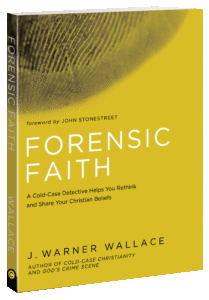 For more information about the nature of Biblical faith and a strategy for communicating the truth of Christianity, please read Forensic Faith: A Homicide Detective Makes the Case for a More Reasonable, Evidential Christian Faith. This book teaches readers four reasonable, evidential characteristics of Christianity and provides a strategy for sharing Christianity with others. The book is accompanied by an eight-session Forensic Faith DVD Set (and Participant’s Guide) to help individuals or small groups examine the evidence and make the case.















SHERRY DUNN
July 6, 2026 at 2:50 pm
So here’s my question: is the family the same thing as the body of believers, the church, when family members are wrong, morally or spiritually disobedient? We can stand up for God’s teachings and principles, but do we kick family members out for wrong doing or wrong living?