







There are several ways people come to hold their beliefs, but not all of them are equally trustworthy. Some of us hold beliefs that are unreasonable—we cling to them even though the evidence points clearly in another direction. Think about someone who still insists that warts come from touching frogs. We now know that’s false, and yet a person might continue to believe it. That’s a belief held in spite of the evidence—a belief that stands against reason.
Then there are blind beliefs—things we accept without ever examining the evidence, sometimes without even realizing evidence exists. I can tell you from my own life, I hold one of these. I believe my father is my biological father. I wasn’t raised by him, and I’ve never taken a paternity test. I hold that belief because it seems reasonable based on what I know, but I don’t have direct evidence. I could be right, or I could be wrong. The point is, the belief isn’t rooted in proof—it’s rooted in trust without verification.
Finally, there’s a third kind of belief—the one I call a forensic belief. This is the kind built on evidence, investigation, and reasoning. These are the kinds of beliefs detectives rely on, and they’re the kinds we should aim for. When I take amoxicillin, for example, I don’t just believe it works because someone said it does. I’ve experienced its effects and read the reports explaining why it works. My confidence is grounded in real data. That’s what a forensic belief looks like—faith informed by facts.
Now, this distinction isn’t just academic. It cuts straight to the heart of our spiritual lives. How do you hold your beliefs about God? Some people hold unreasonable beliefs about God—ideas that contradict what the evidence of history, science, or Scripture shows. Others hold blind beliefs—they inherited their faith or absorbed it from their culture, but they’ve never really tested it. Either way, their beliefs might be right or wrong, but they don’t know why they believe what they believe.
And that’s dangerous. Because when challenges come—when doubts arise, when skeptics ask tough questions—those who believe blindly or unreasonably often find their faith collapsing under pressure. But those who’ve developed forensic faith, who’ve taken the time to investigate, to study, and to understand the evidence that supports what they believe, can stand firm. Their faith is not rooted in wishful thinking but in reasoned conviction. Because when challenges come—when doubts arise, when skeptics ask tough questions—those who believe blindly or unreasonably often find their faith collapsing under pressure. Share on X
Now, does that mean a forensic believer has every question answered or every doubt eliminated? Not at all. No one can build a worldview so airtight that it removes every possible doubt. Even the most reasonable conclusions leave room for some uncertainty. But that doesn’t mean your faith is blind—it means it’s human. The goal isn’t certainty; it’s confidence built on solid ground.

When Christians adopt a forensic mindset, their faith becomes more than emotion or tradition—it becomes conviction. We no longer say, “I just believe because I was raised this way,” but, “I believe because I’ve examined the evidence and found it to be true.” That kind of faith doesn’t waver when culture shifts or when skeptics scoff, because it’s anchored in truth that withstands scrutiny.
This is why I’m so passionate about encouraging believers to make the case for what they believe. Christianity is not a blind leap into the dark; it’s a reasonable step into the light. The evidence for God’s existence, the reliability of Scripture, and the truth of Jesus’ resurrection can all be investigated. And while you’ll never remove every question, you can know that your trust is not misplaced.
At the end of the day, a forensic faith is the only kind of faith strong enough to survive in a skeptical world. It’s the difference between saying, “I believe, but I don’t know why,” and saying, “I believe because I’ve looked carefully—and the evidence leads here.” That’s what it means to hold a faith worth holding, a faith that can stand up to scrutiny and still point unmistakably toward truth.
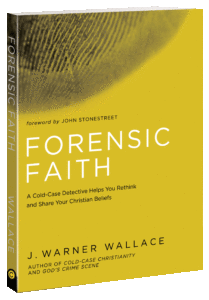 For more information about the nature of Biblical faith and a strategy for communicating the truth of Christianity, please read Forensic Faith: A Homicide Detective Makes the Case for a More Reasonable, Evidential Christian Faith. This book teaches readers four reasonable, evidential characteristics of Christianity and provides a strategy for sharing Christianity with others. The book is accompanied by an eight-session Forensic Faith DVD Set (and Participant’s Guide) to help individuals or small groups examine the evidence and make the case.