
















Becoming a better Christian case maker isn’t about mastering every argument in Christian apologetics or memorizing every answer to every skeptical challenge. It’s about starting with what truly interests you—and building from there.
When I first began this journey, it was because I had encountered a pastor who made some claims about Jesus that I needed to investigate. The evidence for the moral nature of reality captivated me, and that became my starting point. I wanted to understand why things are right or wrong, and how that very sense of morality points back to the moral lawgiver who transcends every culture and human opinion. I didn’t start by diving into cosmology or fine-tuning arguments or quantum physics. I didn’t have a background in the sciences, and that meant venturing into those areas would require a much steeper learning curve. So instead, I stayed with what pulled my attention—the moral argument for God’s existence. That’s where I did most of my reading, my listening, and my early conversations.
That’s what I’d suggest for anyone beginning to make a case for the Christian worldview: start with what captures your curiosity. If you’re a person of science, maybe cosmology, biology, or information theory is where you’ll excel. If you’re an artist, maybe you’ll see and defend the evidence of God through the beauty, purpose, and order in creation. My son is an anesthesiologist. If he sets out to defend the Christian faith, his path would naturally lead through biochemistry and DNA because that’s where his daily experience already lies. It’s where his expertise already lives. His approach to making a case for God will look completely different from mine—and that’s perfectly okay.
You don’t have to know everything. In fact, no one does. It’s far better to know one thing really well than to know a little bit about everything. Focus first. Choose one issue—maybe it’s the resurrection, maybe the reliability of Scripture, maybe the moral character of God—and dig deep. Read the best books. Listen to the best teachers. Test what you read. Grow confident in just that one area. Then, when someone asks a question outside your area of comfort, it’s okay to say, “I’m not sure yet. Let me get back to you on that.” That answer doesn’t show weakness; it shows honesty and commitment. And here’s what happens next: those unanswered questions will nudge you into new areas. You’ll start learning about new aspects of Christian case making one question at a time. In a few years, you’ll realize your depth of understanding has expanded far more naturally than you planned.
Think of it like following sports. You might start out only caring about one team or one player, but before long, you start noticing stats, averages, and records. You start picking up details because curiosity fuels learning. The same is true with truth. Your friends’ questions will push you deeper, and what began as one topic will turn into a handful of areas of expertise.
But here’s the catch: this growth takes discipline. Becoming an informed Christian case maker may mean reallocating the time you normally spend on distractions to something more meaningful. Maybe it’s two hours a week you shift from scrolling social media or watching entertainment to studying apologetics, the Bible, or philosophy. That small shift, over time, turns into something significant. You’ll start finding that even the “fun” or “stupid stuff,” as I like to call it, can serve a purpose—it opens the door to spiritual conversations when you keep it in perspective. Balance it, enjoy it, but let your priority be transformation.

Ultimately, the first step to becoming a better Christian case maker isn’t about acquiring knowledge—it’s about intentional curiosity. It’s about chasing truth in the areas God has already wired you to care about. When you follow that path and stay consistent, you’ll find that the evidence for God becomes not just something you can defend, but something that shapes the way you see the world. And that’s the beginning of a confident, contagious Christian faith.
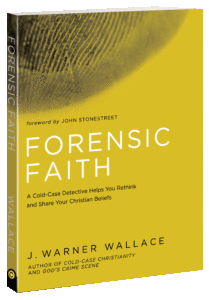 For more information about the nature of Biblical faith and a strategy for communicating the truth of Christianity, please read Forensic Faith: A Homicide Detective Makes the Case for a More Reasonable, Evidential Christian Faith. This book teaches readers four reasonable, evidential characteristics of Christianity and provides a strategy for sharing Christianity with others. The book is accompanied by an eight-session Forensic Faith DVD Set (and Participant’s Guide) to help individuals or small groups examine the evidence and make the case.















Marcella Z Hernandez
May 20, 2026 at 8:18 am
This article turned out to be really important to me. I’ve never thought to determine what part of defending Christianity interests me most and focus on it instead of learning thin, wide and sparse. I’ve been reading and trying to understand it all. It makes more sense pinpoint something and study it deeply. Thank you!