

















 Not long ago, I found myself listening patiently as Mark, a friend of mine, described a difficult conversation he had with a non-believer named Cindy. Mark said he met Cindy at a party and intentionally directed the conversation toward spiritual matters; he hoped to share the gospel with her at some point in the evening. When Cindy learned Mark was a Christian, however, she became very defensive and eventually told him that she was disgusted with Christians and their pro-life position related to abortion. Cindy believed that women should have a right to choose. Mark was prepared to talk about the Gospel but unequipped to navigate the issue of abortion. He was undeterred, however, in his desire to talk about Jesus and the salvation offered on the cross. He pressed on, even though Cindy repeatedly ignored his presentation and grew ever more frustrated as Mark refused to address her concerns about abortion. I wish I could say the story had a happy ending, but Cindy grew so irritated with Mark that she eventually excused herself and avoided him for the rest of the party. Mark told me that he was disappointed Cindy refused to talk with him any further, but he said, “At least she got to hear the Gospel.”
It struck me that this might not have been the most effective way to present the offer of salvation and the character of Christ. While it’s certainly true that God is powerful enough to call people to Himself in any number of ways, Mark’s story reminded me of the difference between “speaking” the Gospel and “sharing” it. In some ways, the difference is similar to the distinction between “teaching” and “preaching.” Scripture often describes these activities as two separate efforts:
Acts 5:42
And every day, in the temple and from house to house, they did not cease teaching and preaching that the Christ is Jesus.
Acts 15:35
But Paul and Barnabas remained in Antioch, teaching and preaching the word of the Lord…
It appears that it’s possible to teach “that the Christ is Jesus” and also preach “that the Christ is Jesus.” What is the difference? I think it comes down to the distinction between “instructing” and “inspiring”.
I can describe the principles of algebra and effectively teach it to just about anyone. That part is easy. Helping people to see the value of algebra and to develop a passion for it; well, that’s another matter altogether. That takes a lot more work. I’ve had adequate teachers who effectively taught me the principles of whatever subject they were assigned. But occasionally I’ve encountered a teacher who took the time to learn about me as a person and communicated the subject matter with the energy and skill necessary to inspire me. I can only think of a handful of inspirational teachers, but they changed the way I thought about life and learning.
When I share the Gospel with someone, I want to make sure I am doing more than instructing them in the basic principles of salvation. I want to do more than teach them about Jesus. While this is a critical aspect of my message, it is not enough. I want to take the time to understand the person with whom I am sharing and compassionately address his or her concerns or objections. I want to be passionate about how I communicate the love of God. I want to do more than instruct; I want to inspire. I want to do more that teach the Gospel; I want to preach it in a way that calls for a response.

It’s easy to speak the truth. But, it’s our choice whether or not we share the truth as a gracious and thoughtful ambassador for Christ. That’s why it’s so important to be prepared to “make a defense to everyone who asks you to give an account for the hope that is in you, yet with gentleness and reverence” (1 Peter 3:15). Good evangelists are also compassionate and effective Christian Case Makers.
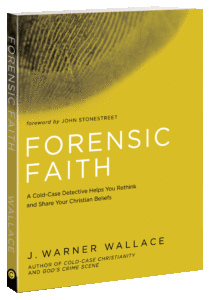 For more information about the nature of Biblical faith and a strategy for communicating the truth of Christianity, please read Forensic Faith: A Homicide Detective Makes the Case for a More Reasonable, Evidential Christian Faith. This book teaches readers four reasonable, evidential characteristics of Christianity and provides a strategy for sharing Christianity with others. The book is accompanied by an eight-session Forensic Faith DVD Set (and Participant’s Guide) to help individuals or small groups examine the evidence and make the case.
J. Warner Wallace is a Dateline featured Cold-Case Detective, Senior Fellow at the Colson Center for Christian Worldview, Adj. Professor of Christian Apologetics at Talbot School of Theology, Biola University, author of Cold-Case Christianity, God’s Crime Scene, and Forensic Faith, and creator of the Case Makers Academy for kids.
Subscribe to J. Warner’s Daily Email


















Pingback: Why Do You Feel Guilty About Evangelism But Not Apologetics? | Cold Case Christianity
Pingback: Are You Properly Motivated as a Christian Case Maker? | Cold Case Christianity
Pingback: Jumping Over the Evangelism Wall | Cold Case Christianity
Pingback: The Frustrating Fallacy of Friendship Evangelism | Cold Case Christianity
Pingback: Are You Properly Motivated as a Christian Case Maker? | TLG Christian News
Pingback: Access Ministries: mini-charity review
Larry
October 4, 2025 at 9:19 am
Why can we Christians no agree to agree with Lord Jesus Holy Spirit interpreted scriptures just as it is written already that any sinner can read. Why are we alooowing private reinterpretation of scripture to end Lord Jesus brotherly love giving through Jesus Holy Spirit Lord Jesus death and resurrection on,y gives to those who love and obey Lord Jesus Christ?