
















 I had the great pleasure and privilege several years ago to speak to students (and visitors) at Rutgers University. Ratio Christi hosted the three hour event. Julie Miller (RC’s Chapter Director at Rutgers) and her husband Buzz did an amazing job organizing and hosting the event. I was asked to defend the reliability of the New Testament Gospels, and afterward we opened the floor for a one hour question and answer session. As part of my case for the reliable transmission of the key claims of the Gospel authors, I retraced the New Testament Chain of Custody for the audience. This sequence of early believers links the eyewitness authors with their immediate students in an effort to examine the content of the original claims of the Gospels. Early Church Fathers like Ignatius, Polycarp and Clement play an important role in this chain of Gospel stewards; the writings of these students of John and Paul help us verify the content of the 1st Century teaching related to Jesus. The ancient letters of these three Church Fathers have great value for this reason. Is the Bible true? These letters are an important piece of evidence.
During the Q and A session, a young man asked an important question, echoing concerns I’ve addressed on other campuses around the country. Here’s the paraphrase: “The Church Fathers wrote about more than what John or Paul taught them about the historical activities and claims of Jesus; they also wrote about theological issues, and many of their theological positions are rejected by non-Catholics. If we reject the theology of some of these men, how can we trust anything else they said? How do we know where to draw the line, and are we just ‘cherry-picking’ as we use what happens to serve our cause (while rejecting the stuff we don’t like)?”
Once again, the best analogy here is a courtroom analogy. There are many times when a witness is asked to describe what he (or she) saw or heard, but there are important limits. I might ask a witness, “What did the suspect say to you?” This kind of question is appropriate and the witness’ response will be allowed in the trial. But if I step beyond this and ask, “Why do you think the suspect said that?” the defense attorneys will likely object to my question before the witness even gets a chance to respond: “Your honor, that’s an inappropriate question, the witness is being asked to offer an opinion, and it’s irrelevant what the witness thinks in this regard. This witness can’t read the mind of the suspect.” It’s one thing to ask a witness to strictly recall what he or she heard, another to offer an opinion about what this means or what may have motivated the statement in the first place.
When there are multiple eyewitnesses used in a criminal trial, there’s a good chance these witnesses will come from a variety of worldviews and lifestyles. They will probably hold a divergent set of beliefs, attitudes and opinions. In fact, they may even have varying opinions about the guilt of the defendant in the case. None of these varying views will be apparent to the jury, however, because our questions on the stand will be limited to the actions or statements of the defendant. In a similar way, the Early Church Fathers provide us with key information related to the statements of the gospel authors. That’s the limit of their testimony and the evidential boundary for which they have value. They may disagree with each other (or later theologians) about what they think we ought to interpret from the life and teaching of Jesus, but that’s outside the scope of their testimony. We simply want to know what John and Paul said about Jesus so we can make sure the Gospels and New Testament letters we have today contain the same information as the originals. I’m not interested in the political, social or theological inclinations of these men; I simply want to know, “What did John and Paul say about Jesus?” The content confirmation of the Early Church Fathers is yet another way to verify the trustworthy nature of the New Testament Share on X
The work of the Early Church Fathers has great value for us as we reconstruct the New Testament Chain of Custody. I’ve written about this Chain of Custody in detail in Cold-Case Christianity. Is the Bible true? The content confirmation of the Early Church Fathers is yet another way to verify the trustworthy nature of the New Testament, even if there are important limits we must respect.
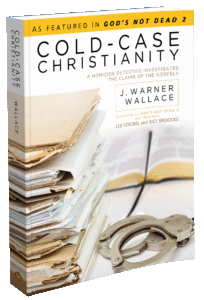 For more information about the reliability of the New Testament gospels and the case for Christianity, please read Cold-Case Christianity: A Homicide Detective Investigates the Claims of the Gospels. This book teaches readers ten principles of cold-case investigations and applies these strategies to investigate the claims of the gospel authors. The book is accompanied by an eight-session Cold-Case Christianity DVD Set (and Participant’s Guide) to help individuals or small groups examine the evidence and make the case.
J. Warner Wallace is a Dateline featured Cold-Case Detective, Senior Fellow at the Colson Center for Christian Worldview, Adj. Professor of Christian Apologetics at Talbot School of Theology, Biola University, author of Cold-Case Christianity, God’s Crime Scene, and Forensic Faith, and creator of the Case Makers Academy for kids.
Subscribe to J. Warner’s Daily Email





Pingback: How to Respond to Claims Jesus Is a “Copycat Savior” (Free Bible Insert) | Cold Case Christianity
Pingback: Real Clear Apologetics | The Case for the Reliability of the New Testament (Free Bible Insert)
Pingback: The Case for the Reliability of the New Testament (Free Bible Insert) | Cold Case Christianity
Pingback: The Case for the Reliability of the New Testament (Free Bible Insert) - Cross Examined - Christian Apologetic Ministry | Frank Turek | Christian Apologetics | Christian Apologetics Speakers
Titus Jr Laxa
August 15, 2020 at 1:50 am
Thank you for this! I appreciate this article. Very timely, as I have recently been having such questions about the Early Church Fathers. Thank you.
Liam
October 21, 2024 at 12:37 am
I think the article should read “…the writings of these students of John and *PETER* help us verify the content…”
Rather than what is says, “… students of John and *PAUL*…”