













It’s a story most of us know, often all too well. If you’re connected with young people—maybe a son or daughter, a grandchild, a niece or nephew—you’ve likely seen or felt the sting of watching someone raised in the church walk away. They hit high school, maybe college, and suddenly the faith they grew up with doesn’t seem to stick. Often, they offer what sound like intellectual objections, but sometimes these are smokescreens for other motives. Whatever the reason, the result is the same: a season away from church, sometimes temporary, sometimes permanent. If you’re honest, you probably have a version of this story somewhere in your own family.
Why does this happen, and what can we do about it? The problem, I’ve found, is that many of us in the church possess what I call “accidental faith.” We grow up with beliefs—beliefs that happen to be true, sure—but we don’t actually know why. We can’t articulate the reasons. Ask why the faith is true, and most of us struggle to respond. Instead, we rest in the comfort of familiar surroundings, blissfully unaware of why those surroundings provide truth rather than mere tradition.
But sooner or later, blind belief will be tested. All it takes is one person—with a persuasive alternative worldview or lifestyle—to provoke doubt and offer a path away from Christianity. Sometimes, what pulls someone away isn’t rigorous intellectual argument but the simple lure of our passions. If a young person feels uncertain about the truth of Christianity, and another worldview promises a more permissive lifestyle, it shouldn’t surprise us when the faith of their childhood is abandoned. That’s often the real story behind the story—the “tail that wags the dog,” so to speak. If a young person feels uncertain about the truth of Christianity, and another worldview promises a more permissive lifestyle, it shouldn’t surprise us when the faith of their childhood is abandoned. Share on X
This is why I’m convinced we need more than a passive, inherited faith. We need a forensic faith—a faith built on solid evidence. Of course, this doesn’t mean that every question will be answered perfectly or that there won’t still be a step of trust required at the end of the day. But it does mean that the journey to belief is marked by a trail of evidence, and that evidence matters. When times get tough, knowing why the faith is true will help you stand tall. It will keep you grounded, even if circumstances aren’t in your favor or you feel the pull to chase your passions for a season. Knowing what’s true through evidence acts like a spiritual rubber band: if you drift too far, returning can be painful, but the truth brings you back to where you belong.
A forensic faith does three crucial things. First, it protects you from false ideas by providing a rational foundation for your beliefs. You’re not easily swayed because you know the “why” behind the “what.” Second, it steadies you in difficult times, giving you confidence and resilience when questions arise or when culture challenges you. Third, it provides a way home after a season of wandering. Everyone makes mistakes; everyone chases “stupid” for a while. But if you’re anchored by evidence—by a knowledge not just of what you believe, but why—you have a clear path back to the truth when you’re ready to return.
In the end, developing a forensic faith isn’t just a matter of intellectual satisfaction. It’s a way to strengthen yourself and those you love, ensuring that passing passions or cultural currents don’t pull you endlessly away from what’s real. Forensic faith is about more than just certainty—it’s about cultivating resilience, clarity, and a genuine connection to truth. That’s the kind of faith worth pursuing, and the kind that welcomes us home when life calls us back.

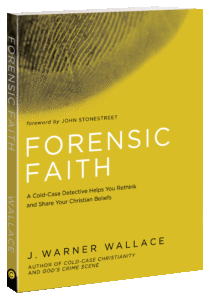 For more information about the nature of Biblical faith and a strategy for communicating the truth of Christianity, please read Forensic Faith: A Homicide Detective Makes the Case for a More Reasonable, Evidential Christian Faith. This book teaches readers four reasonable, evidential characteristics of Christianity and provides a strategy for sharing Christianity with others. The book is accompanied by an eight-session Forensic Faith DVD Set (and Participant’s Guide) to help individuals or small groups examine the evidence and make the case.






Charles Beazley
January 24, 2026 at 12:18 pm
We are saved by grace, not faith. Grace is given to us when God knows our faith is real. Muslims have faith, but it won’t save them. When someone like me accepts Christ at a young age, we don’t know the evidence. I love your work, and the evidence it has provided for me answers to questions I had and learning the amazing truth of God. It has reinforced my faith. For skeptics, it opens for them the possibility of recognizing truth. Then the Holy Spirot must do the rest. As you teach, we must go from belief that to belief in.