














Apologetics has always held a vital place in my own walk as a Christian and in the life of the Church. Yet I’m not surprised when I see confusion among believers about what role it really plays. Some ask, if we’re already teaching Scripture, why do we need apologetics? Isn’t the Word itself powerful enough to change hearts? Of course, Scripture is living and active, but one of the things that stands out to me as I study the Bible is just how evidential it is. From beginning to end, Christianity has always been a faith grounded in evidence.
When you read the Gospels, you can’t help but notice that Jesus rarely preached without performing miracles that confirmed His message. In John’s Gospel, Jesus even says, “If you don’t believe what I’m saying, at least believe on the evidence of the miracles.” After His resurrection, Acts 1 records that He spent forty days with the disciples, giving them many convincing proofs that He was alive. Why would the risen Christ spend over a month proving Himself to those who already believed in Him? Because He knew those men and women were going to be His eyewitnesses. He commissioned them to go out and testify to what they had personally seen and experienced. That is direct evidence. Jesus placed an incredibly high value on direct evidence.
Even when John the Baptist sent messengers to Jesus with doubts—asking, “Are you the One?”—Jesus didn’t scold them. He didn’t say, “Tell John to have more faith.” Instead, He performed miracles before their eyes and told them, “Go back and tell John what you’ve seen.” In other words, He pointed them to evidence. Jesus Himself modeled the very thing we now call apologetics. When the apostles later stood before hostile audiences in the book of Acts, they didn’t rely merely on emotion or persuasion—they presented the evidence of what they had witnessed. They made a case for what they knew to be true.
So why, then, do some in the Church resist apologetics? Part of it comes from a sincere theological concern. We believe the Word of God has power. We believe no one can come to Christ unless the Father draws them. That’s true. But human beings also build walls—barriers of doubt, skepticism, or bad information—that can prevent them from hearing the gospel clearly. Those walls have to come down before they can really listen. Human beings build walls—barriers of doubt, skepticism, or bad information—that can prevent them from hearing the gospel clearly. Share on X
For someone like me, who spoke the language of evidence, I needed someone to learn to speak my language before I could truly hear the gospel. That’s all apologetics really is—learning to speak the language of a culture that no longer sees the Bible as authoritative or even comprehensible. Think of it this way: if you went to a country where no one spoke English, you wouldn’t preach the gospel in English and expect people to understand. You’d translate it into their language. Today, our culture has its own language—one of skepticism, science, and self-determination. Many people can’t even begin to grasp Scripture because it sounds foreign to them. Learning to present evidence, reason, and historical truth is simply our way of translating the gospel into that language.
That’s why I see apologetics and evangelism as being inseparable—joined at the hip. In fact, I’d argue they’re the same thing. Apologetics is evangelism through translation. It’s not about winning arguments or showing off knowledge; it’s about removing obstacles that keep people from hearing the message of Jesus clearly. Sometimes all that stands between a person and faith is an unanswered question or an intellectual barrier they’ve held for years. When we help clear that away, the Word of God can finally be heard.

Apologetics doesn’t replace evangelism. It is evangelism—just done with the care of someone who’s taken the time to learn another person’s language. When we learn that language, we make the gospel audible again to a culture that has forgotten how to listen.
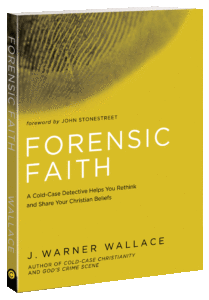 For more information about the nature of Biblical faith and a strategy for communicating the truth of Christianity, please read Forensic Faith: A Homicide Detective Makes the Case for a More Reasonable, Evidential Christian Faith. This book teaches readers four reasonable, evidential characteristics of Christianity and provides a strategy for sharing Christianity with others. The book is accompanied by an eight-session Forensic Faith DVD Set (and Participant’s Guide) to help individuals or small groups examine the evidence and make the case.




Alan H. McLeod
March 13, 2026 at 7:43 pm
I agree that apologetics is appropriate but the dynamics are more than intellectual and include spiritual blindness. Pray and the role of the Holy Spirit are critical.