















If you’ve got a son or daughter in high school or college—or a niece, nephew, or grandchild—you probably know the story I’m about to describe. A young person grows up in the church, attends youth group, memorizes verses, and maybe even serves in ministry. Yet somewhere along the way, that same young person decides it isn’t for them. They say they don’t think it’s true, or they raise intellectual objections that sound sophisticated—sometimes just as an excuse to avoid belief altogether. But regardless of the reason, they walk away. For some, it’s temporary. For others, it’s permanent. Almost every Christian family I talk to has lived this heartbreak.
That story raises a haunting question: why does it happen? Why do so many of our sons and daughters leave the faith? I’m convinced that one reason is that too many of us have inherited an accidental faith. We’re Christians because we were raised this way, because our parents brought us to church, or because it just “feels right.” We happen to believe something that’s true—but we often can’t explain why it’s true. We know what we believe, but if someone presses us on why we believe it, we stammer. We can’t make the case. And when our children watch that happen, they internalize it. They begin to think our faith is just a matter of blind belief—and who wants to ground their life on blind faith in a skeptical age?
Sooner or later, that kind of belief gets challenged. Someone comes along—maybe a professor, a friend, or a content creator online—who seems more thoughtful, more confident, and more persuasive. And if a young person’s faith wasn’t anchored in evidence but built on comfort, culture, or convenience, it begins to crumble. Add to that our fallen human nature—our desire to chase passions rather than truth—and you’ve set the stage for apostasy. Let’s be honest: if you’re a teenager who’s uncertain Christianity is true, but you encounter a worldview that allows you to indulge your appetites without guilt, it’s easy to say goodbye to Christianity. That’s the tail that wags the dog. Belief becomes a casualty of desire.
But that’s precisely why our faith must be more than emotional or cultural. It must be forensic. We need a faith that can stand up to cross-examination—a faith grounded in evidence. This doesn’t mean we have every answer or can eliminate the need for trust. Even a detective reaches a point in the investigation where the evidence is clear enough to warrant a verdict, even though not every question is answered. The same is true for belief in God. We can follow the trail of evidence to a reasonable conclusion, and then we take a step of trust—not a blind leap, but a confident one.
An evidence-based faith changes how we respond when storms hit. When you know something is true evidentially, your emotions don’t dictate your devotion. You may struggle, doubt, or even wander for a season, but truth has a way of pulling you back. It’s what I sometimes call “rubber band theology”—the further you stretch away from truth, the more it hurts when you snap back. Evidence holds you steady when emotions or temptations try to sway you. An evidence-based faith changes how we respond when storms hit. When you know something is true evidentially, your emotions don’t dictate your devotion. Share on X
That’s why we need to help our young people—and ourselves—develop a forensic faith. It’s not just about winning arguments; it’s about enduring through life’s toughest moments. A forensic faith keeps us from being tossed around by false ideas. It steadies us when life doesn’t go as planned. And when we’ve spent a season “chasing stupid,” as I like to say, it’s the tether that brings us home.

In the end, faith built on evidence is faith built to last. When you know why Christianity is true, you’re far less likely to abandon it when the cultural winds shift—or when your feelings fade. You stand tall because you know what you believe and why. That kind of confidence isn’t arrogance—it’s conviction. And in a world full of doubts and distractions, conviction is exactly what we, and our kids, need most.
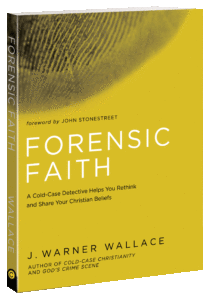 For more information about the nature of Biblical faith and a strategy for communicating the truth of Christianity, please read Forensic Faith: A Homicide Detective Makes the Case for a More Reasonable, Evidential Christian Faith. This book teaches readers four reasonable, evidential characteristics of Christianity and provides a strategy for sharing Christianity with others. The book is accompanied by an eight-session Forensic Faith DVD Set (and Participant’s Guide) to help individuals or small groups examine the evidence and make the case.